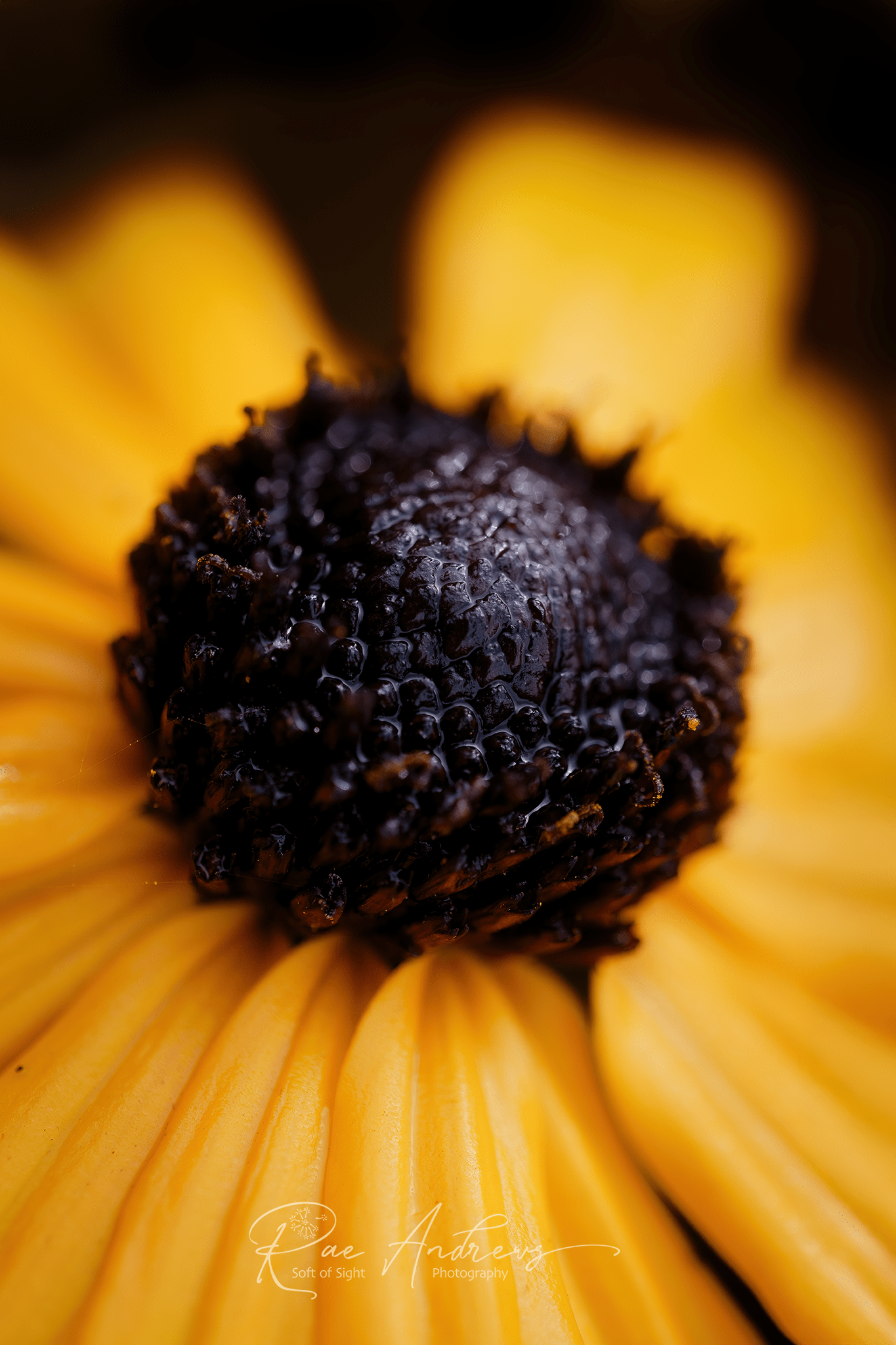
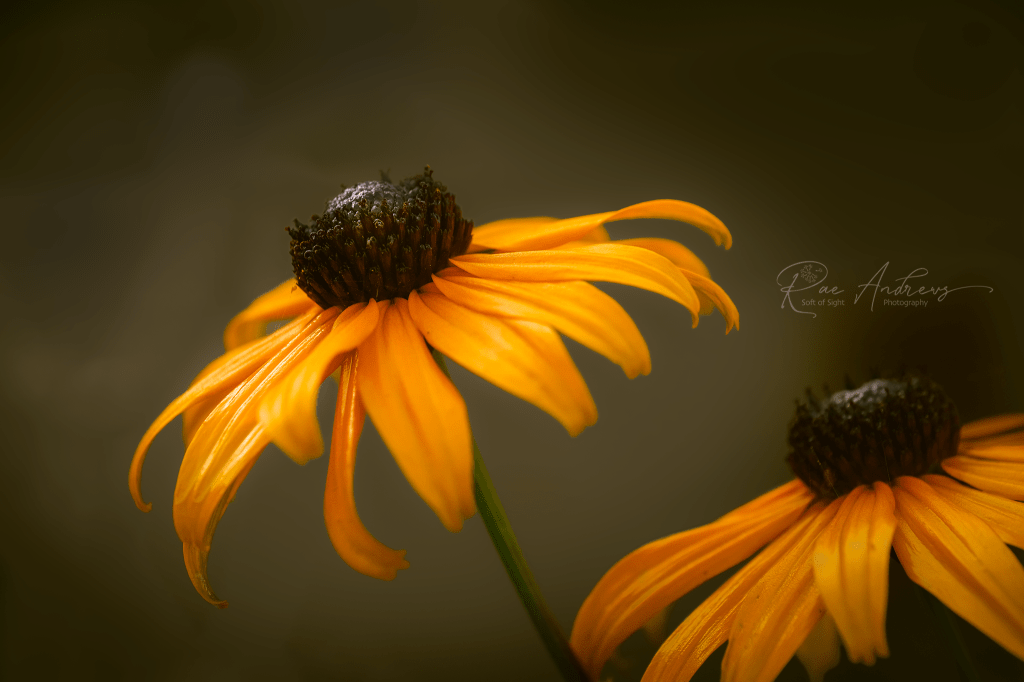
Captured in the gentle hush of early evening in the back garden, two images of the same rudbeckia plant – currently showing a profusion of bold, daisy-like blooms whose golden egg yolk yellow petals still glow in the low light.
In the first image, we’re drawn so close we could almost the flower beneath our fingertips. The camera lingers on the flower’s centre – a dark, domed disc that’s almost black in colour, but glistens with hints of deep plum and treacle brown where the evening light falls across the mysterious surface. It looks tough, almost reptilian, a dense circular cluster of tightly packed scales, each catching the light like polished obsidian. Around it, the yellow-orange petals curve outward in soft ridges – not flat like paper, but textured, almost waxy, their shape sculpted by nature’s patient hand.
In the second image, we pull back to see the flower in full. Leaning gently to the side (or perhaps the photographer can’t find a straight horizon  ) on its long green stem, as if bowing to the last warmth of the day. Its petals are long and loose, some beginning to curl and dip downward. Another bloom waits behind it in the warm muted background, slightly out of focus, as if to echo the first.
 Soft of Sight Photography